New Directions in the Philosophy of Memory by Kourken Michaelian Dorothea Debus Denis Perrin
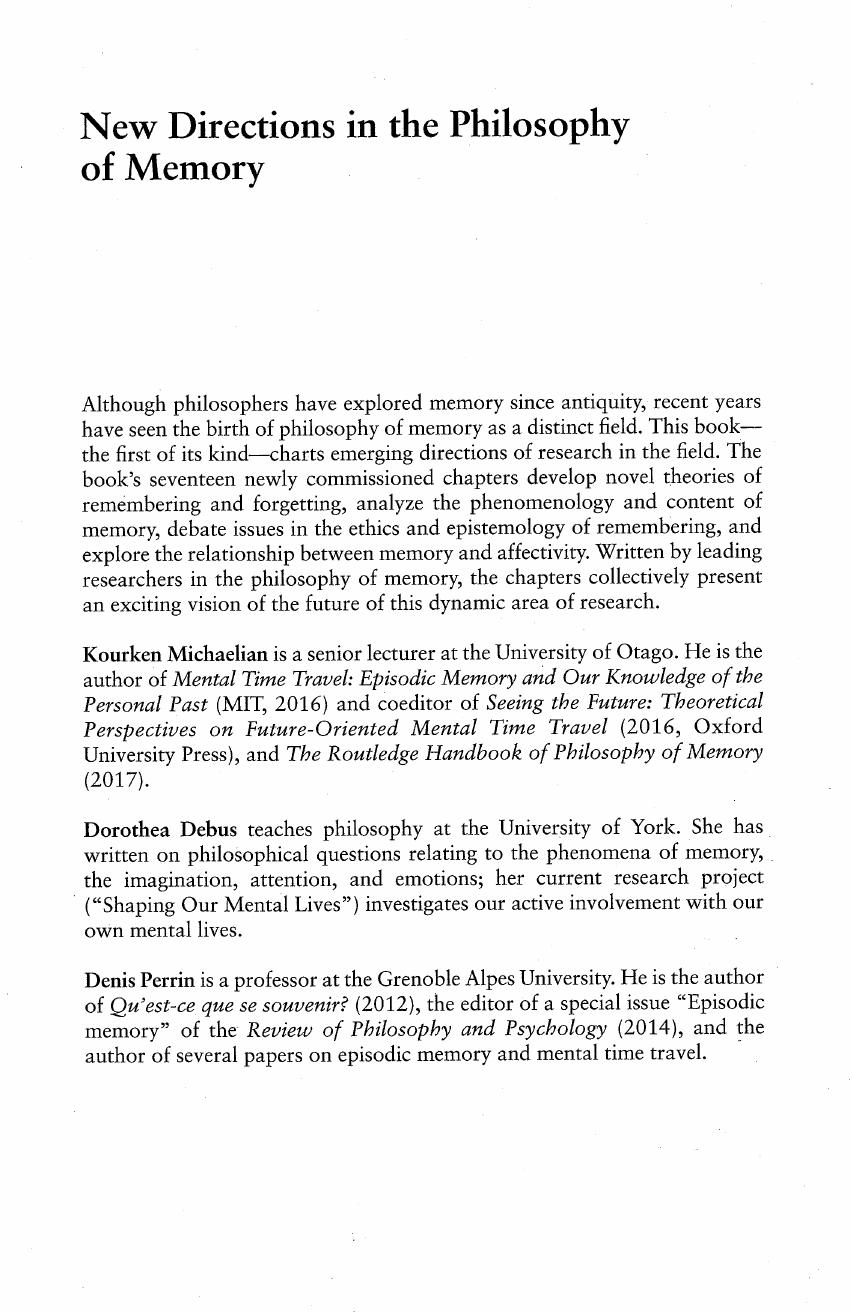
Author:Kourken Michaelian,Dorothea Debus,Denis Perrin
Language: eng
Format: epub, pdf
Publisher: Taylor & Francis (CAM)
Published: 2018-03-14T00:00:00+00:00
Part IV
Memory in Groups
9âShared Remembering and Distributed Affect
Varieties of Psychological Interdependence
John Sutton
One significant feature of human life is our psychological interdependence. To greater or lesser extents, and across diverse cultural contexts, our cognitive and affective states are related to those of others around us. We act alongside and share experiences with partners, family members, friends, workmates, and other people with whom we are connected in our daily lives. And as a result, what each of us feels and remembers, what matters to each of us about the present and the past, and the way we imagine and plan for the future, can be influenced by what those others feel, remember, and care about. This occurs in the moment, when my emotions or moods, my decisions or thoughts, are modulated by the actions or reactions, judgments, or evaluations of someone close to me. But it also happens over time, and in many cases over years, decades, or lifetimes. Such interdependence does not mean that we think, remember, or feel the same way about things. In many cases, it matters greatly to me when the emotions or memories of someone I care about differ from my own. Our psychological lives can in certain circumstances be interdependent and mutually influencing, to different degrees and in different ways integrated with each other, whether or not the precise content or style of our thoughts, memories, and feelings happens to match.
This chapter integrates four recent trends in philosophy of memory and philosophy of cognitive science, all addressing such phenomena of psychological interdependence. First, the ways that remembering is typically integrated or entwined with other cognitive and affective processes, with imagining and feeling, are acknowledged and highlighted (Sutton, 2009; Keightley & Pickering, 2012; Goldie, 2012). Second, social aspects of memory are seen as potentially beneficial: other people are not only sources of error or misinformation, but can in certain circumstances support and collaboratively structure the form and content of recall (Campbell, 2008; Sutton, 2008). Third, memory is a test case for claims that cognition can be extended or (better) distributed across an array of heterogeneous cognitive ecologies, spanning neural, bodily, social, and environmental resources (Sutton et al., 2010; Tollefsen, Dale, & Paxton, 2013), and relatedly for ideas about collective intentionality (Michaelian & Sutton, 2017). Fourth, in a more recent literature on which I focus, emotions too are seen as potentially distributed across body and world as well as brain (Colombetti & Krueger, 2015).
I aim to identify tight and underappreciated links between these four points, especially between the social nature of remembering and the distribution of affective phenomena. Because memory is often in use when it is not explicitly in question, theorists whose primary attention is on another domain may not see just how heavily it is implicated. Just as plausible accounts of decision-making in group agency place demands on mechanisms of group memory to keep track of and use history effectively (Sutton, 2008), so a range of interacting forms of remembering are involved in the phenomena of âdistributed affectivityâ (Slaby, 2016).
Download
New Directions in the Philosophy of Memory by Kourken Michaelian Dorothea Debus Denis Perrin.pdf
This site does not store any files on its server. We only index and link to content provided by other sites. Please contact the content providers to delete copyright contents if any and email us, we'll remove relevant links or contents immediately.
| Anthropology | Archaeology |
| Philosophy | Politics & Government |
| Social Sciences | Sociology |
| Women's Studies |
The remains of the day by Kazuo Ishiguro(8951)
Tools of Titans by Timothy Ferriss(8348)
Giovanni's Room by James Baldwin(7302)
The Black Swan by Nassim Nicholas Taleb(7090)
Inner Engineering: A Yogi's Guide to Joy by Sadhguru(6776)
The Way of Zen by Alan W. Watts(6578)
Asking the Right Questions: A Guide to Critical Thinking by M. Neil Browne & Stuart M. Keeley(5741)
The Power of Now: A Guide to Spiritual Enlightenment by Eckhart Tolle(5730)
The Six Wives Of Henry VIII (WOMEN IN HISTORY) by Fraser Antonia(5488)
Astrophysics for People in a Hurry by Neil DeGrasse Tyson(5170)
Housekeeping by Marilynne Robinson(4421)
12 Rules for Life by Jordan B. Peterson(4292)
Double Down (Diary of a Wimpy Kid Book 11) by Jeff Kinney(4252)
The Ethical Slut by Janet W. Hardy(4233)
Skin in the Game by Nassim Nicholas Taleb(4224)
Ikigai by Héctor García & Francesc Miralles(4219)
The Art of Happiness by The Dalai Lama(4116)
Skin in the Game: Hidden Asymmetries in Daily Life by Nassim Nicholas Taleb(3977)
Walking by Henry David Thoreau(3941)
